


Mental Health Progress
As Rebecca’s Dream enters its 15th year of providing hope; help and encouragement to individuals and families living with mental health diseases, we take a brief look at changes occurring in the world of mental health as reported by Joseph Rauch in his article “A 2016 Report on Progress and Failures in Mental Health” (Talkspace.com).
Rauch mentions the rise of telehealth as an advancement in accessibility in addition to the option of physically walking into a therapist or psychiatrist’s office in his article (Talkspace.com). While these platforms have limitations, they have opened the door to 24/7 access to mental health care in many states. In addition to Rauch’s point, there is the added benefit that this type of mental health care helps to alleviate worry about stigma, and it is adjustable for personal schedules.
Rauch also noted the increase of awareness and education through social media. In addition, the World Bank and the World Health Organization (WHO) focused on making mental health a high priority at their April 2016 Conference, according to Rauch in his “2016 Report on Progress and Failures in Mental Health” (Talkspace.com). Rauch wants us to recognize how far society has come in acknowledging and talking about mental illness. As this area still has a lot of ground to cover, organizations such as Rebecca’s Dream are paving the way to make sure everybody sees the need not only for conversations to happen, but for those conversations to be respectful and caring. Disparaging and denigrating words continue to cloak mental illness, therefore, Rebecca’s Dream continues to promote awareness and compassionate understanding of depression and bipolar disorder as real diseases.
Hollywood is waking up to the reality of living with mental illness, either as an individual or as a family member, friend or co-worker.
What had been a source of comedy and black humor is now (usually) treated with respect. What was a taboo topic is now recognized as a societal issue which continues to need education, as noted by Rauch’s examples in his article (Talkspace.com).
Rauch also noted the continued perception of those who suffer from mental illness as being more violent has led to the need for education and training for police and community helpers. Too many people are needlessly shot by police who have limited understanding of signs and symptoms of fragile individuals. Those living with mental illness are more likely to harm themselves than harm others.
Fifteen years ago society was woefully uneducated regarding those who need our help most of all.
Progress has been made. Accomplishments are many. Yet, we still live in a world of stigma, myth and misunderstanding regarding mental health. In our next article we will discuss the stigma surrounding mental health and the work that still needs to be done in this area. In the meantime, Rebecca’s Dream continues to fight the good fight. We move onward and forward for the greater good.
Thank you for standing with us. We are grateful. Our community is grateful. Someday, the world will be grateful.
Source: Talkspace.com, 2016 Report on Progress and Failures in Mental Health
Rebecca’s Dream wishes you and your loved ones a compassionate Thanksgiving Holiday!
With thanks and gratitude for your ongoing support of Rebecca’s Dream,
The Rebecca’s Dream Team.

There are many ways to become involved in #GivingTuesday. Join the movement. You will feel a sense of accomplishment and joy.
Thank you.
With gratitude and appreciation,
Rebecca’s Dream
In past years more than 45,000 organizations in 71 countries came together to celebrate this global event. Since its’ founding in 2012 #GivingTuesday has resulted in greater donations, volunteer hours and activities that bring about real change to communities. We invite you to join the movement and GIVE this December 3rd.
A few ideas include:
Rebecca’s Dream College 2020 Scholarships in memory of Dr. Harlan Haimes
DEADLINE DECEMBER 1, 2019
Rebecca’s Dream is a 501(c)3 Foundation, committed to serving the community by promoting awareness and compassionate understanding of depression and bipolar disorder as real diseases. The Rebecca’s Dream Scholarships are an opportunity for high school senior students to address the serious issue of stigma associated with mental illness.
Three applicants will be awarded a $1,500 scholarship each.
“Resilience is not about overcoming but becoming.”
-Sherri Mandell
Upcoming Events

Celebrating 21 years!
Get Tickets Today! (click here)
Join us in celebrating 21 years of Rebecca’s Dream—championing mental health, fighting stigma, and raising awareness for prevention and early intervention.
Tickets are now available:
Dreamer – $150
Dream Friend – $175
Each Dream Friend ticket includes 2 Cash Raffle tickets.
Next Generation Dreamer – $100
Are you age 30 or younger? Rebecca’s Dream invites you to attend at a reduced rate.
Dream Group – $1,350
Bring a group of 10. Company or group recognition.
$500 Cash Raffle – $25/ticket or 5 tickets for $100
___________________________________
Click to become a sponsor
In the Comments section, please enter “Sponsorship.” A Rebecca’s Dream team member will follow up to gather any additional information needed, including your name or company logo for sponsor recognition.
We invite you to partner with us as a sponsor for this year’s Rebecca’s Dream Benefit. Your sponsorship directly supports our mission to promote mental health awareness and education while honoring Rebecca’s legacy.
Each level of sponsorship offers meaningful opportunities for recognition, community engagement, and visibility both at the event and across our communication channels. From naming rights to social media promotion and on-site branding, there’s a level to match your desired impact.
Explore the sponsorship levels below and join us in making a difference.
Platinum Sponsor – $10,000
Top-tier sponsorship with naming rights, logo placement across all event materials, prominent online and media recognition, a special stage mention, and 10 event tickets.
Silver Sponsor – $7,500
High-level visibility with logo on banner, registration table, invitation, and online platforms; recognition in media and at the event; includes 8 event tickets.
Bronze Sponsor – $5,000
Strong presence with your logo on key signage, the benefit invitation, the website, and social media; featured in press and the e-newsletter; includes 6 event tickets.
Partner Sponsor – $2,500
Valuable support level with logo on signage, online recognition, and social media mentions; includes 4 event tickets.
Barrel Sponsor – $1,000 
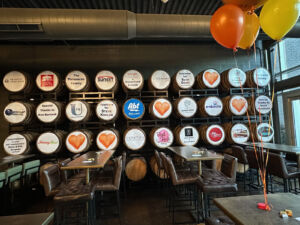
Company name and logo featured on a wine barrel at the venue; includes 2 event tickets and online recognition.
Supporter – $500
Barrel sponsor logo or message and pre- and post-event recognition.
Additional sponsorship opportunities are available.
Contact Kathleen Illes at killes@rebeccasdream.org or 773-423-7326 to learn more.




“IT’S ALL IN YOUR HEAD”

‘’IT’S ALL IN YOUR HEAD” contains information about: ADHD, depression, anxiety, bipolar disorder, OCD, stigma, symptoms and ways to cope.
Author and illustrator Marlee F. Is a teen living successfully with depression. As Marlee struggled to understand her thoughts, feelings and moods she created “IT’S ALL IN YOUR HEAD.” Marlee’s passion became helping teens easily understand they are not alone during difficult mental health challenges ~ help she wishes she had during her early years of confusion and shame.
Mental disorders don’t discriminate.
One in five teens are affected by some form of disorder severe enough to impact their daily lives.
However, with professional help and self-care most teens feel better within 4-6 weeks.

Tips & Tools
Tips for the Caregiver
Living with a person who has depression can be very difficult and stressful on family members and friends. Here are some suggestions for living with a person who has depression that may make things easier for you and more beneficial for the depressed person:
Source: WebMD
Featured Book


